
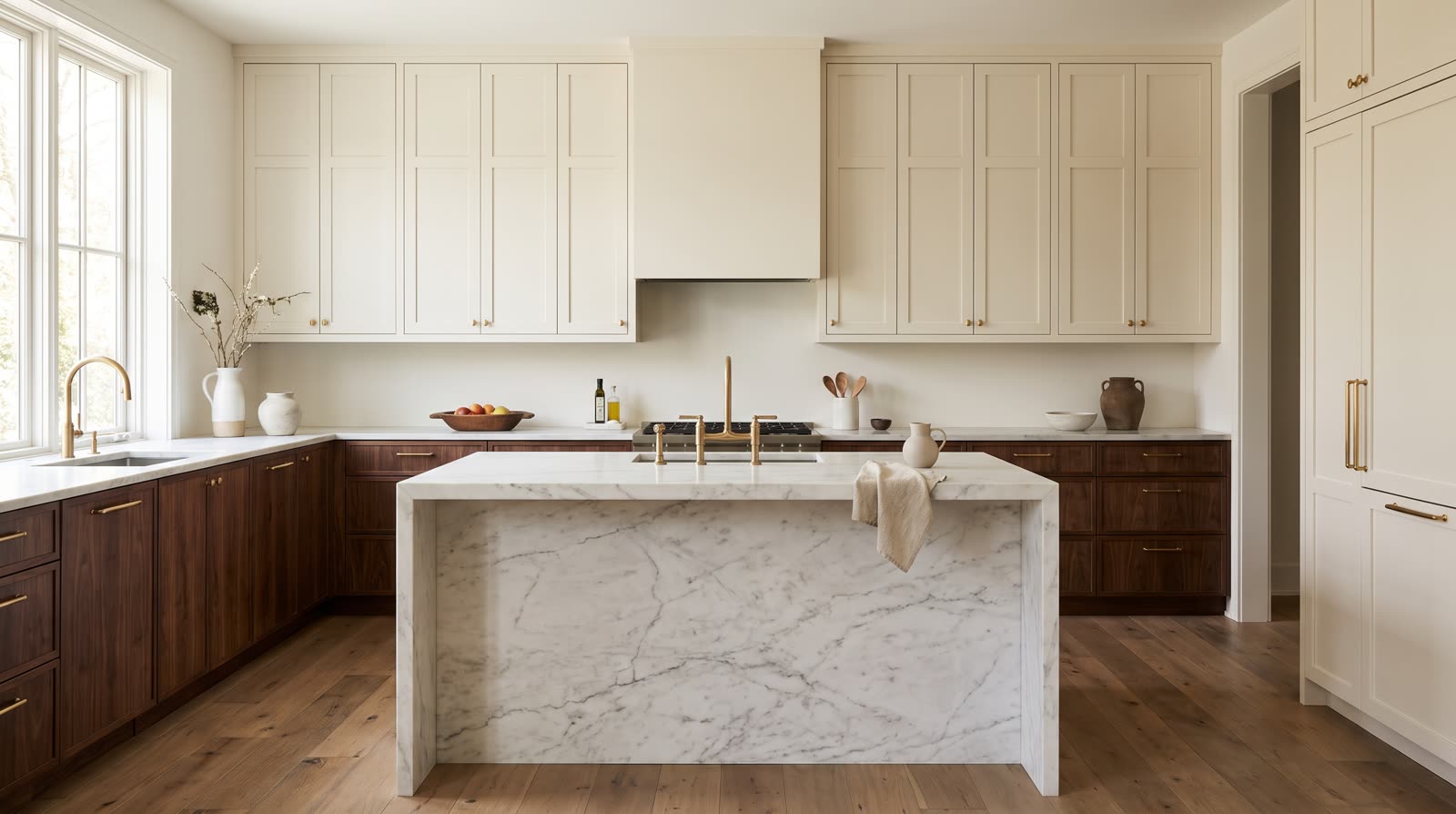
What are custom kitchen cabinets?
Custom kitchen cabinets are made for one kitchen. A cabinetmaker measures the actual room, draws the layout, and builds each box, door, and drawer to those numbers. Nothing is pulled off a shelf in standard three-inch increments. If your ceiling is nine feet and four inches, the uppers reach nine feet and four inches.
That is the real difference. Stock and semi-custom cabinets start from fixed sizes and fill the gaps with filler panels. Custom work starts from your walls and leaves no gaps to fill. The result fits the way a piece of furniture fits, because it was built the same way.
It also means every decision is yours. Door style, wood species, finish, drawer depth, the height of the toe kick, where the spice pull-out lives. On a custom job those are choices, not constraints.
84 percent of renovating homeowners update their cabinetry, and 68 percent replace the cabinets entirely.2026 U.S. Houzz Kitchen Trends Study (n=1,780, fielded July 2025)
Cabinetry is where most kitchen renovations begin, and it is the part of the room that gets touched every day for decades. That is why the construction and the maker matter more than any single trend.
How much do custom kitchen cabinets cost?
Custom cabinets are the most expensive of the three tiers, and the range is wide because the work varies so much. A simple painted run is one number. A walnut wall with integrated, panel-ready appliances is another.
Custom kitchen cabinets run about $150 to $1,200 per linear foot, against roughly $35 to $81 for stock and $90 to $650 for semi-custom.This Old House, "All About Kitchen Cabinets"
Where a project lands inside that band depends on a few honest factors. Wood is the biggest one. Painted poplar costs less than rift-cut white oak, which costs less than walnut. Finish is next: a sprayed conversion-varnish finish and a hand-rubbed oil finish take different amounts of labor. Then there is hardware, the number of specialty pull-outs, and how square the room is to begin with.
One useful way to read a quote is to ask what is driving the number. A good cabinetmaker can tell you which line items move the total and which ones do not. That conversation is worth more than a single headline figure.
What raises the price the most?
- Wood species. Walnut and rift-cut oak cost more than maple, poplar, or paint-grade stock.
- Finish. Multi-step stains, glazes, and hand-rubbed oils take more labor than a single sprayed coat.
- Specialty interiors. Roll-out trays, mixed-material drawer organizers, and appliance garages add build time.
- Integration. Panel-ready refrigeration and concealed dishwashers ask for tighter tolerances and custom panels.
Framed vs frameless: which should you choose?
This is the question that gets the most debate and matters the least to most homeowners. Both are well-built ways to make a cabinet. The right answer is mostly about the look you want.
Framed cabinets have a face frame, a flat wood border around the front of the box. Doors and drawers mount to that frame. It is the traditional American method, it is forgiving to service years later, and it suits inset and shaker looks. Frameless cabinets, sometimes called full-access or European, skip the face frame. The doors cover the whole box, which gives slightly more interior room and a flush, continuous front that reads modern.
| Framed | Frameless | |
|---|---|---|
| Look | Traditional, inset, shaker | Modern, flush, slab |
| Interior space | Slightly less | Slightly more |
| Service over time | Very forgiving | Forgiving, tighter tolerances |
| Best with | Classic and transitional kitchens | Contemporary kitchens |
We build both. A painted inset kitchen wants a face frame. A matte slab kitchen with a book-matched wood wall, like our matte-black slab and walnut kitchen, is happier frameless. Neither is more custom than the other. They are two grammars for the same sentence.
What wood is best for kitchen cabinets?
There is no single best wood. There is the right wood for the finish you want. Here is how the common choices behave.
- Maple and poplar. Tight, even grain that takes paint cleanly. The default for a crisp painted shaker or inset kitchen.
- White oak. Plain-sawn for a soft cathedral grain, rift-cut for straight, quiet lines. Holds a natural or light stain beautifully.
- Walnut. Deep brown with real movement in the grain. Expensive, worth it as an accent wall or an island rather than a whole room.
- Cherry. Warms and darkens with age. A classic for traditional kitchens, less common in modern work.
For painted cabinetry, the wood barely shows, so the conversation is really about a stable, paint-friendly species and a durable finish. For stained or oiled cabinetry, the wood is the whole show. That is when species, cut, and grain matching earn their cost. Our walnut library paneling is a good example of letting one wood carry a room.
Custom, semi-custom, or stock: what is the difference?
These three tiers describe how much of the cabinet is made to order. Knowing where the lines fall keeps a quote honest.
| Tier | How it is made | Best for |
|---|---|---|
| Stock | Pre-built in fixed sizes, filled out with panels | Tight budgets, simple square rooms |
| Semi-custom | Standard sizes with finish and modification options | Some personalization at a middle price |
| Custom | Drawn and built to the exact room, no fixed sizes | Odd layouts, specific materials, a furniture-grade result |
If your kitchen is a plain rectangle and your budget is firm, stock or semi-custom can serve you well. Custom earns its premium when the room is irregular, when you care about a specific wood or finish, or when you want the whole thing to feel built rather than assembled. There is no shame in any tier. There is only the right tier for the room.
How long do custom kitchen cabinets take?
Longer than most people expect, and that is a feature, not a delay. Custom cabinets are built after they are ordered, not pulled from a warehouse.
Industry-wide, lead times for custom cabinets run from eight weeks to six months. In our own shop the build is six to ten weeks, followed by one to two weeks of installation on site. From first meeting to a finished kitchen, a full custom project usually takes about twelve to sixteen weeks once design and the proposal are settled.
Those weeks break into four phases: an in-person consultation and measure, design and a written proposal, the shop build, and the on-site install. We send weekly photos through the build so you can watch your kitchen take shape on the bench.
What does the process actually look like?
Good custom work follows a clear order, and the drawing comes before any wood is cut. We draw first on purpose. A drawing is where mistakes are cheap to fix.
- Consultation and measure. We see the room, talk through how you cook, and take real measurements.
- Design and proposal. Drawings, materials, finishes, and a written price. Nothing is built until this is agreed.
- Shop build. Six to ten weeks at the bench, with weekly photos.
- Install. One to two weeks on site, fit by the same team that built it, with a punch list cleared before the final walkthrough.
At our workshop the same hands carry the job through all four stages. Felix draws it, the shop builds it, and the shop installs it. That continuity is the quiet reason custom work fits the way it does.
How do you choose a cabinetmaker?
The maker matters more than the door style. A plain shaker door built well outlasts an ambitious design built poorly. When you are comparing shops, the questions below tell you more than a showroom ever will.
- Who draws, builds, and installs? One shop through all four stages means fewer handoffs and clearer accountability.
- Can I see finished work? Real projects in real homes, ideally near you, beat catalog renderings.
- What drives the price? A maker who can explain the line items is a maker who understands the work.
- How do you handle the install? An in-house install team protects the tolerances the build depends on.
- What is the honest timeline? A specific answer in weeks signals a shop that plans, not one that hopes.
You can see the range of what a shop is capable of in its finished work. Our project portfolio covers everything from a painted shaker waterfall island to a regency dual vanity, which gives a fair read on how a single shop handles very different rooms. For the full breakdown of what we build, the services page lays out kitchens, baths, paneled rooms, and built-ins with honest timelines for each.
Frequently asked questions
Are custom kitchen cabinets worth the cost?
For the right kitchen, yes. Cabinetry is the surface you touch every day and the structure everything else attaches to, so it is the one part of a renovation where build quality compounds over decades. If your room has standard dimensions and you are happy with catalog sizes, semi-custom can serve you well. If the room has odd walls, high ceilings, or you want the kitchen to fit like furniture, custom is what actually delivers that.
Do custom cabinets use plywood or MDF?
Usually both, in different places. Plywood is the standard for boxes because it holds screws well and shrugs off moisture. MDF earns its place in painted doors, where its stability keeps paint from cracking at the joints the way solid wood can. A shop that tells you MDF is always a shortcut, or that solid wood is always better, is selling a story rather than explaining the material.
Can you add to or restore existing cabinetry instead of replacing it?
Often, yes. Wood restoration and refinishing is one of our five service lines. If the boxes are sound, refinishing doors or building matching additions can save most of the cost of a full replacement. An honest shop will tell you when the existing work is worth keeping.
How far ahead should you book a custom kitchen?
Plan on three to four months from first call to finished install. Design and drawings take a few weeks, the build runs six to ten weeks in the shop, and installation takes one to two weeks on site. Booking ahead of a larger renovation keeps the cabinetry off the critical path.
Planning a kitchen?
If you are weighing custom cabinetry for your own renovation, a short call with the workshop is the calmest way to find out what your room actually needs. No pressure, no obligation.
Book a 30-minute call with the workshopLast updated July 2, 2026 · Premier Cabinets Innovations, Citrus Heights, since 1985