
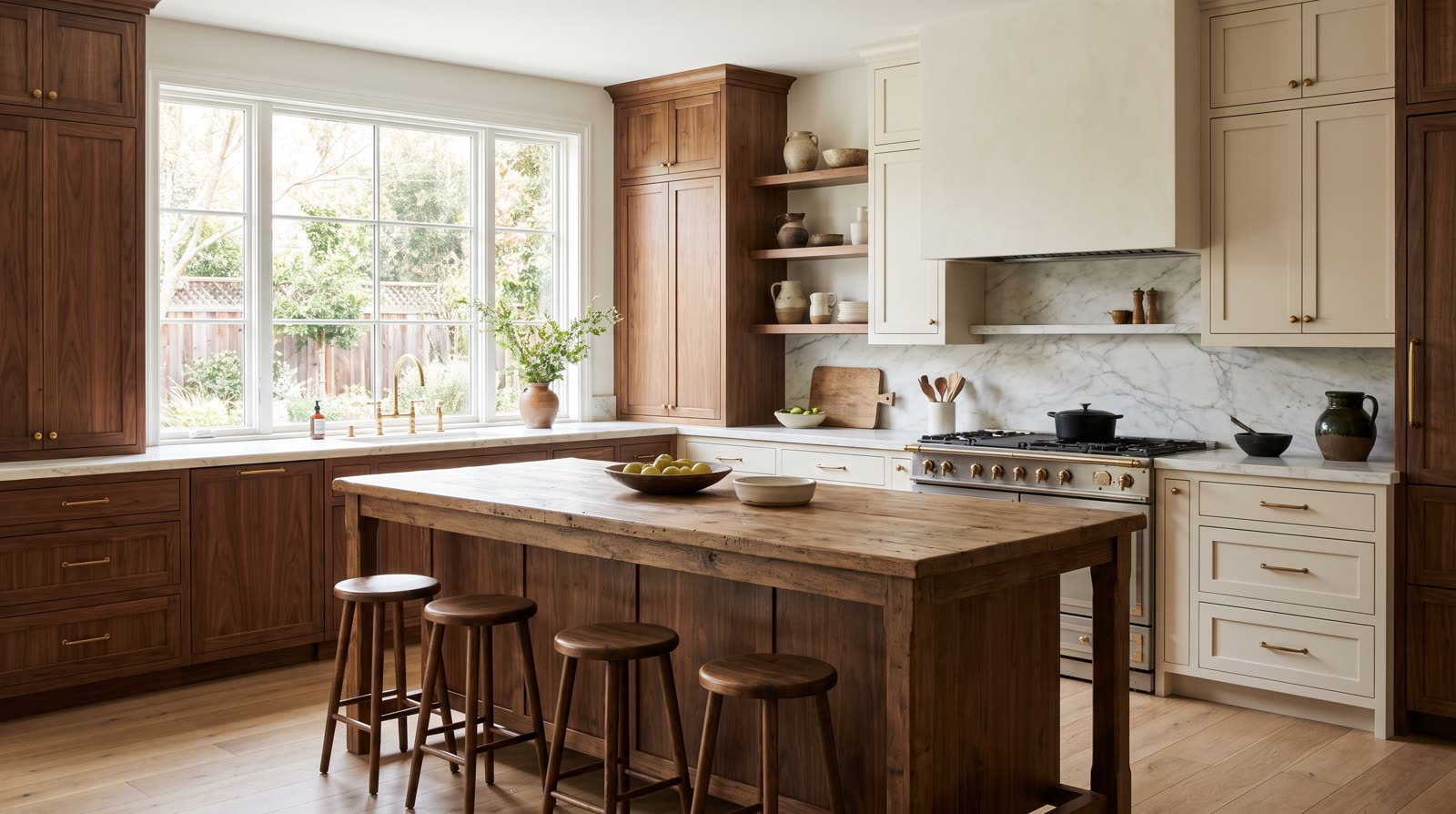
What do custom kitchen cabinets cost per linear foot?
Cabinets are usually priced by the linear foot, which is the length of wall they cover measured along the floor. It is the cleanest way to compare quotes, because it strips out the size of the room and leaves you with the rate for the work itself.
Custom kitchen cabinets cost about $500 to $1,200 per linear foot installed, compared with roughly $100 to $300 for stock and $150 to $650 for semi-custom.HomeAdvisor, "What Do Custom Cabinets Cost to Install?" (2025 data)
Those national ranges hold up well in the Sacramento area. Local labor and a healthy supply of skilled trades keep the region close to the middle of the band rather than at the coastal extremes you see in San Francisco or Los Angeles. A custom kitchen here tends to read as fair value for genuinely made-to-order work.
The reason the range is so wide is that custom means custom. A simple painted run of cabinets is one number. A book-matched walnut wall with integrated, panel-ready appliances is a very different one. The rate per foot is really a rate for the choices inside each foot.
What does that mean for a whole Sacramento kitchen?
Most kitchens carry somewhere between 20 and 35 linear feet of cabinetry once you count the uppers, the lowers, and the island. A mid-sized Sacramento-area kitchen of about 25 to 30 linear feet, built custom, usually lands between $15,000 and $50,000 for the cabinets alone.
That is a real spread, so here is how to read it. The lower end is a clean painted shaker kitchen in a paint-friendly wood with a straightforward layout. The upper end is a larger room with premium species, a hand-applied finish, specialty interiors, and integrated appliances. Both are custom. They simply ask for different amounts of material and labor.
| Kitchen | Linear feet | Typical custom range |
|---|---|---|
| Small / galley | 15 to 20 ft | $9,000 to $24,000 |
| Mid-sized | 25 to 30 ft | $15,000 to $36,000 |
| Large / open plan | 35 to 45 ft | $22,000 to $54,000 |
These figures cover cabinetry and installation only. They are a starting frame for a conversation, not a quote. A real number comes from measuring your actual room, which is the first thing any honest shop will want to do.
What drives the price up the most?
Four factors move a custom quote far more than the rest. Knowing them lets you steer the budget yourself rather than feeling at the mercy of a single headline figure.
- Wood species. Walnut and rift-cut white oak cost more than maple, poplar, or paint-grade stock. For a painted kitchen the wood barely shows, so this is where many homeowners save without losing anything they can see.
- Finish. A single sprayed conversion-varnish coat is one level of labor. Multi-step stains, glazes, and hand-rubbed oils are another. Finish is quiet on the drawing and loud on the invoice.
- Specialty interiors. Roll-out trays, mixed-material drawer organizers, appliance garages, and pull-out pantries each add build time at the bench.
- Appliance integration. Panel-ready refrigeration and concealed dishwashers ask for tighter tolerances and custom panels, which raise both material and labor.
Layout matters too. A room that is square and plumb is cheaper to fit than one with sloping floors, bowed walls, or a century of settling. Older Sacramento homes in Land Park or East Sacramento often carry a little of that character, and custom work is precisely what absorbs it without filler strips.
Custom, semi-custom, or stock: which should you budget for?
The three tiers describe how much of the cabinet is made to order, and the price climbs with that. Picking the right tier is the single biggest budget decision before any wood is chosen.
| Tier | Per linear foot, installed | Best for |
|---|---|---|
| Stock | $100 to $300 | Tight budgets, simple square rooms |
| Semi-custom | $150 to $650 | Some personalization at a middle price |
| Custom | $500 to $1,200 | Odd layouts, specific materials, a furniture-grade result |
If your kitchen is a plain rectangle and your budget is firm, stock or semi-custom can serve you honestly. Custom earns its premium when the room is irregular, when you care about a specific wood or finish, or when you want the whole thing to feel built rather than assembled. There is no shame in any tier. There is only the right one for the room and the budget. For a deeper look at how the tiers differ in construction, the complete guide to custom kitchen cabinets walks through each one.
What is not included in a cabinet quote?
A common surprise is assuming the cabinet number is the kitchen number. It rarely is. A custom cabinet quote covers the boxes, doors, drawers, finish, and installation. Several real costs sit outside it.
- Countertops. Stone, quartz, or solid surface is a separate trade and a separate line.
- Appliances. The cabinets can be built to receive them, but the appliances themselves are yours to buy.
- Plumbing and electrical. Moving a sink, adding outlets, or wiring under-cabinet lighting is licensed work.
- Demolition and disposal. Removing the old kitchen and hauling it away has a cost, especially in older homes.
- Flooring and paint. Often refreshed at the same time, and worth budgeting alongside the cabinets.
Building your budget around the whole kitchen, not only the cabinets, is the surest way to avoid a mid-project shortfall. A good cabinetmaker will tell you plainly which parts are inside the quote and which are not.
How should you budget for a custom kitchen?
Start with the cabinets, because they anchor everything else, then build outward. A workable approach looks like this.
- Measure your run. Pace the perimeter and the island to estimate your linear feet, then apply the ranges above for a first frame.
- Pick your tier honestly. Decide whether the room genuinely needs custom or whether semi-custom would serve it. This is the largest lever.
- Choose where to spend the wood budget. Paint where the wood will not show, save the walnut for the island or one feature wall, and the number behaves.
- Add the surrounding trades. Counters, appliances, and labor belong in the plan from day one, not as surprises later.
- Hold a contingency. Set aside roughly ten percent for the unknowns an older home tends to reveal once the old kitchen comes out.
Time is part of the budget too. In our own shop a custom kitchen runs six to ten weeks of build, then one to two weeks of installation on site, which usually means about twelve to sixteen weeks from a settled design to a finished room. Planning the timeline early keeps the budget from being squeezed by a rush later.
Kitchen work more than holds its value. Zonda's 2025 Cost vs. Value report puts a minor kitchen remodel at 112.9 percent of its cost recouped at resale, a $28,458 project returning $32,141, the only interior project in the national top five.Zonda, 2025 Cost vs. Value Report
That figure describes a modest refresh rather than a full custom build, but it makes the underlying point: money spent on the kitchen is money buyers can see, and cabinetry is the part of the kitchen they open, close, and judge first.
Why does experience change the value of the number?
Two quotes at the same price per foot are not always the same value. The difference is who stands behind the work and whether the same shop carries it from drawing to install.
Premier Cabinets Innovations has built custom cabinetry from the same Citrus Heights workshop since 1985, which is forty-one years at one bench. Felix draws the kitchen, the shop builds it, and the shop installs it, the same hands through all four stages. That continuity is part of what you are paying for. There are fewer handoffs, clearer accountability, and a tolerance kept tight because the team that built the cabinets is the team that fits them.
You can see how that reads in finished rooms across very different budgets. A painted shaker kitchen with a waterfall island sits at one end of the spend, a matte-black slab and walnut kitchen nearer the other, and a marble and chandelier kitchen shows what a larger budget buys. Seeing the range in real homes is the fairest way to judge what a number actually delivers. For the full breakdown of what we build and the honest timeline for each, the services page lays it out.
Frequently asked questions
Is it cheaper to reface or replace kitchen cabinets?
Refacing or restoring is usually the smaller number, when the boxes deserve it. If the existing cabinet boxes are square and sound, refinishing doors or building matching additions can save most of the cost of a full replacement. If the boxes are failing, refacing is money spent on a structure that will not carry it. Restoration is one of our five service lines, and an honest assessment costs nothing.
Why do quotes for the same kitchen vary so much between shops?
Because the quotes rarely describe the same work. One number may include installation, hardware, and finishing while another leaves them out. One shop builds plywood boxes, another particleboard. Ask each shop what is inside the number and who does the installation, and the spread usually explains itself.
Does custom cabinetry hold its value at resale?
Kitchen work is the best-returning interior project in the country, as the Zonda figure above shows: a minor kitchen remodel recoups 112.9 percent of its cost at resale. Well-built cabinetry is the part of the kitchen buyers open, close, and judge first, and it is the part that still works properly twenty years on.
Does a first conversation with the workshop cost anything?
The 30-minute call with the workshop carries no obligation. It is the calmest way to find out what your room actually needs and what the honest number looks like before anything is drawn.
Pricing your own kitchen?
If you want a real number for your room rather than a range, a short call with the workshop is the calmest place to start. We measure, we draw, and we tell you plainly what drives the cost. No pressure, no obligation.
Book a 30-minute call with the workshopLast updated July 2, 2026 · Premier Cabinets Innovations, Citrus Heights, since 1985