
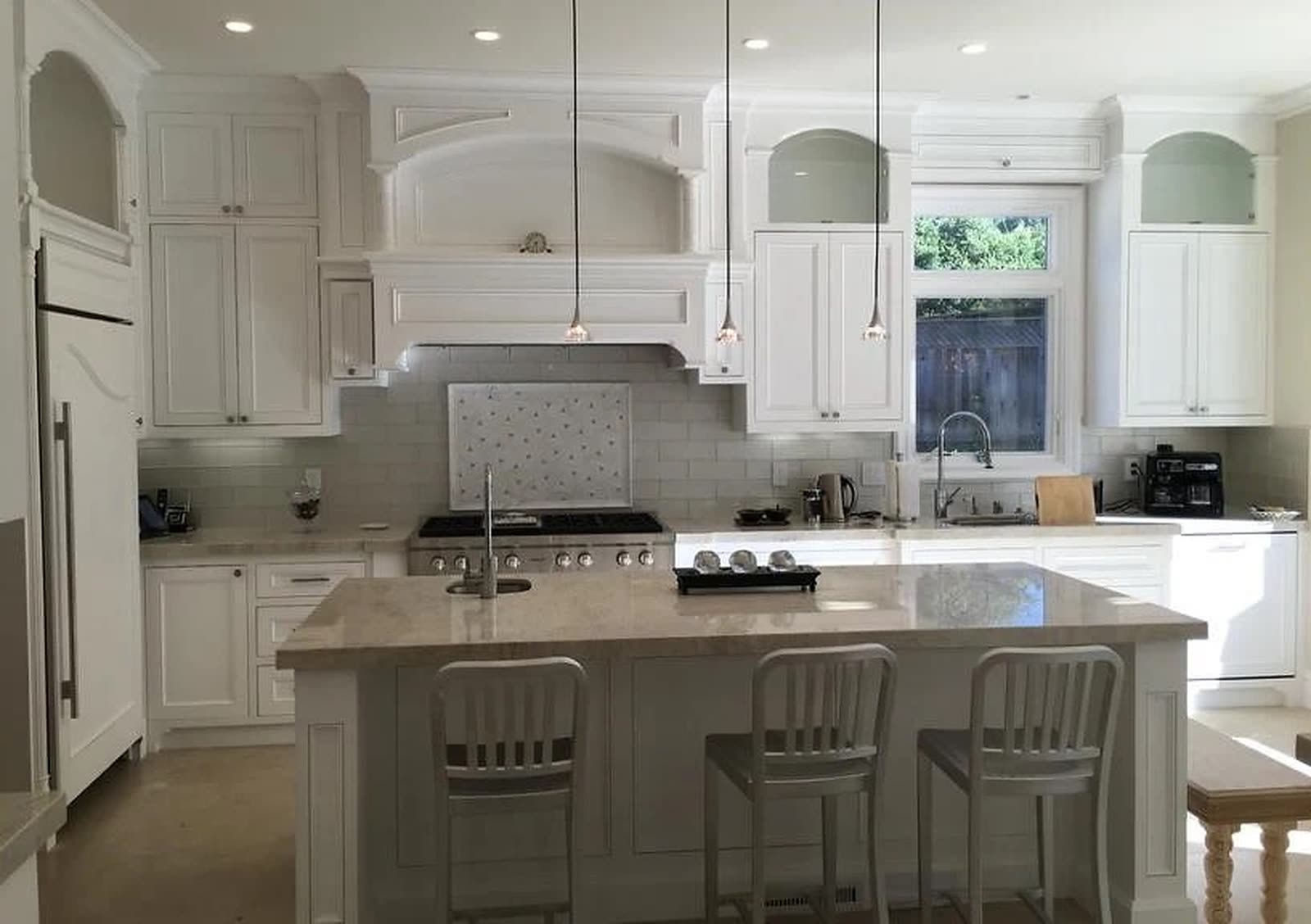
What are the main cabinet door styles?
Nearly every cabinet door built today is one of four things. A shaker door is five pieces: two stiles, two rails, and a flat panel recessed inside them. A slab door is one uninterrupted plane. A raised panel door is built like a shaker but with a center panel that is profiled and stands proud of the frame. A beaded door is a shaker with a fine bead cut along the inside edge of the frame.
Everything else named in a showroom is a variation on those four. Flat panel and recessed panel are both other words for shaker. Mullion doors are shaker frames with glass where the panel would be. The vocabulary is larger than the actual set of choices.
The decision carries weight because the door is most of what you see. Boxes disappear behind fronts, so the style sets the register of the room before anyone notices the wood, the stone, or the hardware.
Eighty-four percent of homeowners renovating a kitchen update their cabinets, making cabinetry the single most-changed feature in the room.2026 U.S. Houzz Kitchen Trends Study (n=1,780)
What is a shaker door, and why is it everywhere?
The shaker door is a frame of four pieces around a flat recessed panel. It comes from nineteenth-century Shaker furniture, where ornament was a moral question and the answer was no. What survived is a door with no profile, no relief, and nothing to date it.
That is precisely why it is everywhere. Painted a soft white it reads as a classic kitchen. The same door in rift-cut white oak reads as a modern one. The door did not change; the finish did. No other style carries that range, and range is what people are quietly buying when they choose shaker without knowing why.
It is also honest about its construction. A well-made shaker shows tight, even corners and a panel that floats freely in its groove, so the wood can move with the seasons without splitting the frame. A poorly made one telegraphs its joints within two winters. Our painted transitional kitchen is the version we build most often, and the cream shaker pantry shows the same door doing quieter work.
The one criticism worth taking seriously is ubiquity. Shaker is the safe answer, and safe answers are sometimes just unexamined ones. If the room wants to say something specific, another style may say it better.
What is a slab door, and where does it belong?
A slab door is one flat surface with no frame and no panel. It belongs in modern kitchens, and it is the only style that makes a handle-less kitchen possible, because there is no frame to interrupt a continuous grain run or a touch-latch edge.
It is the simplest door to draw and the most demanding to build correctly. A shaker frame restrains its panel mechanically. A slab has no such help. It stays flat only because the core is stable and the two faces are balanced, meaning whatever goes on the front, veneer or paint or lacquer, must be matched on the back. Shops that skip the back face save an hour and buy a cupped door in year three.
Slab also puts the material on stage. Every imperfection in the substrate shows through paint, which is why we build them on engineered cores rather than solid wide boards. In wood, the grain has nowhere to hide, so the boards must be matched across the run. Our matte-black and walnut kitchen is a slab kitchen, and its walnut was selected board by board for that reason. Which species suits a slab is a longer conversation, and we work through all four in our guide to the best wood for kitchen cabinets.
Is inset a door style or a construction choice?
Inset is not a door style, and this is the most common confusion we hear at the workshop. It describes where the door sits: flush inside the cabinet frame rather than laid over the front of it. Any of the four styles can be inset. An inset shaker and an overlay shaker are the same door, hung differently.
The distinction matters because inset is the most expensive decision available in cabinetry. An overlay door covers the frame, so a small error in the box disappears beneath it. An inset door sits inside the frame with a reveal of roughly three thirty-seconds of an inch all the way around, and that gap is on display. Every box must be square, every door fitted individually, and the wood given room to swell in summer without binding shut.
That is why inset costs what it does. The price reflects the tolerance the door is fitted to, and the hours required to hold that tolerance across a whole run of cabinets. Our white inset kitchen built around a refrigerator surround shows those reveals running across a full run of cabinets.
Whether the cabinet has a face frame at all is the decision underneath this one, and we cover it in framed versus frameless cabinets. Inset requires a frame. Frameless cabinets are always full overlay.
What about raised panel and beaded doors?
A raised panel door is built like a shaker, but the center panel is profiled at its edges so it rises toward the middle and stands proud of the frame. It throws a shadow line a flat panel cannot, and it is the correct door for a genuinely traditional kitchen. In a Tuscan or formal room, nothing else reads right.
It is also the style most capable of aging badly, though the door is rarely at fault. Raised panel in a heavy honey stain is what most people picture when they picture a dated kitchen. What they are remembering is the stain. The same door in a chalky painted white is timeless.
A beaded door is a shaker with a small bead cut along the inner edge of the frame. It sounds like a detail, and it is, but a demanding one: the bead must be mitered at each corner rather than run through, so every joint becomes a small piece of joinery. Beaded inset is the most exacting cabinetry we build, and the quietest. Most people who see it register only that the room feels considered.
How do the door styles compare?
| Style | Construction | Reads as | Relative cost | Cleaning | Best for |
|---|---|---|---|---|---|
| Shaker | Five pieces, flat recessed panel | Traditional or modern, set by finish | Moderate | Four inside corners | Almost any kitchen |
| Slab | One plane on a stable core | Modern, quiet, material-led | Moderate, high in wood | Easiest, one wipe | Handle-less and modern rooms |
| Raised panel | Five pieces, profiled proud panel | Formal and traditional | High | Profiled edges collect | Traditional and formal kitchens |
| Beaded | Shaker plus a mitered inner bead | Refined, historic, understated | Highest | Bead collects | Considered period work |
Read the cost column carefully. It ranks the doors against each other and says nothing about the price of a finished kitchen. The door is one line in a quote that also carries boxes, drawers, hardware, finish, and installation, so moving from shaker to raised panel changes the total less than the table suggests. Moving from overlay to inset is the change that genuinely moves the number. Our Sacramento-area cost guide spells out where the money goes.
Which door style should your kitchen use?
Decide the finish before the door. That order surprises people, but it resolves most of the question on its own.
Wood tones now lead white as the most popular cabinet finish in America, twenty-nine percent to twenty-eight, the first time wood has been in front in the study's history.2026 U.S. Houzz Kitchen Trends Study (n=1,780)
That shift matters because paint and wood ask for different doors. Paint sits well on a frame, so shaker or raised panel makes sense. Visible grain fights a frame, because the frame interrupts the run and forces the grain to change direction four times on every door. Wood wants a slab, or a shaker with a deliberately quiet panel.
The short version of the conversation we have at the bench:
- A painted kitchen that will still look right in twenty years. Shaker.
- Visible wood, modern and calm. Slab, on a stable core, grain matched across the run.
- A traditional house you want the kitchen to agree with. Raised panel, in a chalky painted finish rather than a heavy stain.
- A room that feels considered without announcing itself. Beaded, and inset if the budget allows.
- One element leading. A slab island against a shaker perimeter, or the reverse.
If you are working through the whole decision rather than this piece of it, our complete guide to custom kitchen cabinets covers construction, materials, timeline, and cost in one place.
Frequently asked questions
Will a shaker kitchen look dated in ten years?
We do not think so. The shaker door has been in continuous use since the nineteenth century and has outlived every trend that briefly replaced it. What dates a shaker kitchen is rarely the door. It is the finish color, the hardware, and the countertop, all of which can be changed later without touching the boxes.
Can you mix door styles in one kitchen?
Yes, and it is done well more often than people expect. A slab island against a shaker perimeter is the common version, and it reads as deliberate rather than confused. The rule we work to is that one style leads and the other answers. Two styles competing for the lead is what makes a room feel unresolved.
Do slab doors warp?
A poorly built one will. A slab door is a single wide surface with nothing to restrain it, so it depends entirely on the substrate. Built on a stable core with balanced veneer or finish on both faces, a slab door stays flat for decades. Built from solid wide boards with a finish on the show face only, it will cup. This is a shop question, not a style question.
Which door style is easiest to keep clean?
Slab, and it is not close. One flat plane wipes in a single pass. Shaker has four inside corners where the rails meet the panel, and raised panel adds a profiled edge that collects more still. None of them are difficult, but if a low-maintenance surface is the priority in a hard-working kitchen, the slab door earns its keep.
Planning a kitchen?
If you are weighing door styles for your own renovation, a short call with the workshop is the calmest way to find out what your room actually needs. No pressure, no obligation.
Book a 30-minute call with the workshopLast updated July 16, 2026 · Premier Cabinets Innovations, Citrus Heights, since 1985